About BEYOND BARRIERS
Building fairer research careers for underrepresented and marginalized researchers
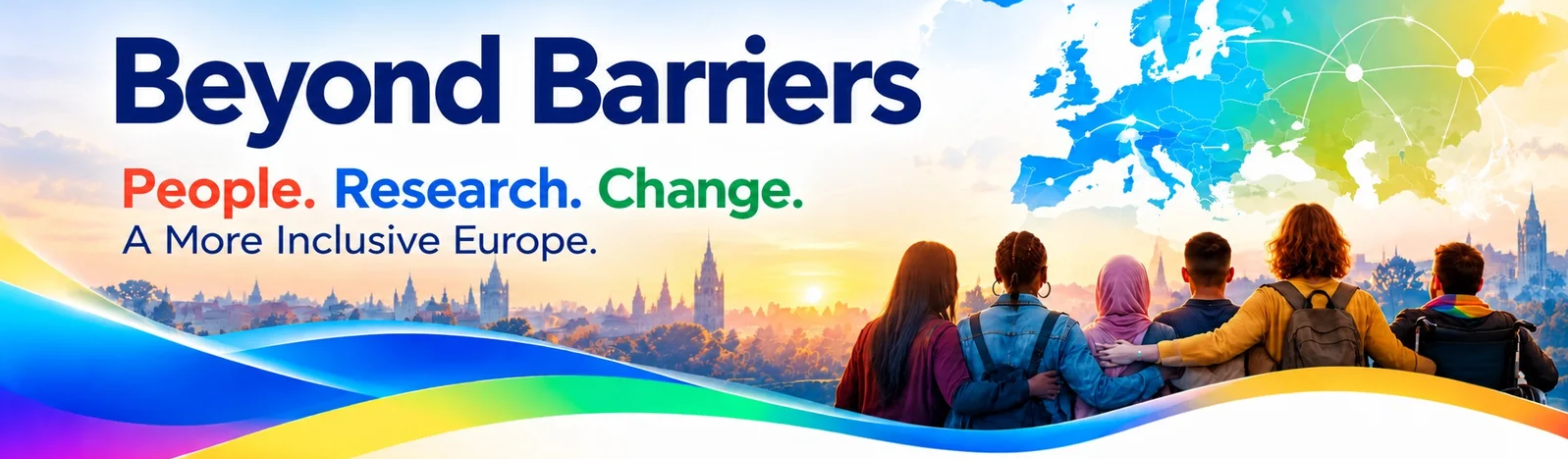
BEYOND BARRIERS is a European research project. We study how barriers arise in research careers and institutions, work with the people affected, and develop practical guidance, tools, training, and policy advice to support lasting change.
The project brings together research, collaboration, and practical resources through five connected directions of work — EXPLORE, ENGAGE, GUIDE, EQUIP, and EMBED. It is coordinated by the University of Oslo and funded by the European Union under the Horizon Europe programme.
Barriers That Hold Researchers Back
Not every researcher gets a fair chance to enter, progress, and stay in a research career. The barriers some face are not just personal setbacks — they are tied to how research is organised, assessed, and resourced, and they can last a whole career.
BEYOND BARRIERS focuses on how systems and organisations shape careers, rather than treating barriers as a matter of individual resilience. Researchers can face barriers linked to access, progression, recognition, opportunities, working conditions, institutional practices, and policy and funding. The project studies both these barriers and the conditions that enable fairer careers.
From Evidence to Structural Change
BEYOND BARRIERS takes an approach that is intersectional, systemic, evidence-based, and collaborative.
It considers how different forms of disadvantage can overlap at the same time; looks beyond individual experiences to the conditions that produce them; builds on evidence and on lived experience; and works with researchers, organisations, and others to develop responses together.
The work follows a connected chain of focus:
Career Barriers
Obstacles that hold some researchers back.
Research Careers
How people enter, progress, and stay.
Research Environments
The places and conditions of everyday research.
Institutional Practices
Routines, rules, and everyday decisions.
Policy
Funding, assessment, and system-level choices.
Lasting Structural Change
Fairer chances that do not depend on who you are.
Researchers Who Are Often Underrepresented or Marginalized
The project centres on four groups of researchers who are often left behind in European research careers:
Racialized and ethnic minority researchers
Researchers who face exclusion or disadvantage because of racialized or ethnic minority identities.
Researchers with migrant or refugee backgrounds
Researchers whose careers are shaped by migration, displacement, or refugee and at-risk scholar status.
Researchers with disabilities
Researchers with disabilities (physical, sensory, cognitive, and others) who face barriers in research environments.
LGBTQIA+ researchers
Researchers who face barriers linked to sexual orientation, gender identity, or gender expression.
Experiences can overlap. Careers are also shaped by factors such as gender, age, social and economic circumstances, parental status, nationality, religion, and employment type. A person can face more than one barrier at once, so the project takes an intersectional approach, looking at how these factors combine rather than treating them separately.
Working Within the Wider European Research System
The European Research Area (ERA) is the shared space where European countries work together on research and innovation. BEYOND BARRIERS aims to help build an ERA where researchers have fairer chances regardless of who they are.
The project is developing an ERA EDI Framework (Equity, Diversity and Inclusion Framework) that complements established research-integrity guidance — in particular the ALLEA European Code of Conduct for Research Integrity, which already exists. The new framework is being developed; it does not replace that code but sits alongside it, adding a clear focus on equity, diversity, and inclusion in research careers. The detail is on our Methodology page.
Explore the Project in More Depth
Read about what the project does, how the research works, or what it aims to change.