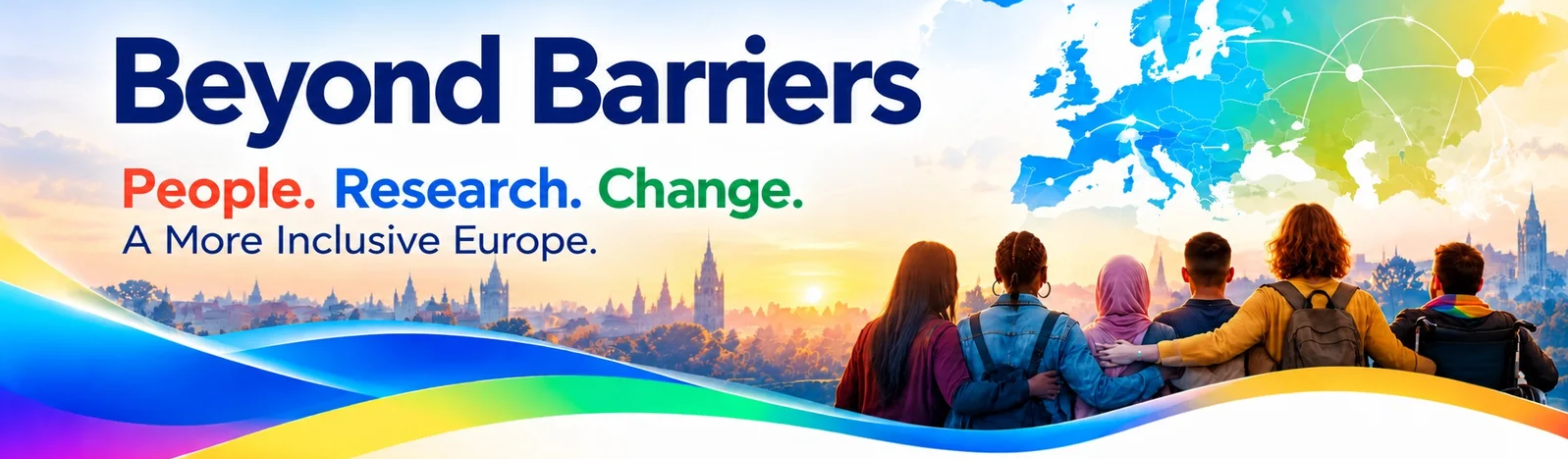
How We Do the Research
BEYOND BARRIERS studies what holds some researchers back and what helps them succeed. We listen to researchers across 10 European countries and combine different kinds of evidence to understand the problem clearly.
What We Are Looking At
We study the barriers and the helpful conditions that shape research careers. We look at four areas:
- Getting in and getting on: how researchers enter, advance, and stay in research.
- Being recognised: how contributions are valued, and access to funding, networks, mentoring, and resources.
- Working conditions: contracts, job security, and everyday research environments.
- Rules and decisions: how organisations’ routines, rules, and funding choices shape careers.
Where the Research Takes Place
Research takes place across 10 European countries. This is different from where the consortium is based. The consortium has 13 partners — 12 institutions and one individual contributor — in eight European countries and the Philippines.
Research across 10 European countries
The project studies barriers and enabling conditions for researchers across 10 European countries. Select a country to explore the research and results as they become available.
Map boundaries based on Eurostat GISCO administrative boundary data. Country selection and highlighting are project-specific.
Select a research country on the map or from the list below to see its information. Country-specific research and results will appear here as they become available.
All 10 Research Countries
The project’s research geography includes the following 10 European countries. Select a country to see the same information shown on the map.
Who the Research Focuses On
The project centres on four groups of researchers who are often left behind in European research careers:
- Racialized and ethnic minority researchers — people who face exclusion linked to racialized or ethnic minority identities.
- Researchers with migrant or refugee backgrounds — people whose careers are shaped by migration, displacement, or refugee status.
- Researchers with disabilities (physical, sensory, cognitive, and others) who face barriers in research environments.
- LGBTQIA+ researchers — people who face barriers linked to sexual orientation, gender identity, or gender expression.
How Experiences Overlap
A person can face more than one barrier at once. These can combine with other factors such as gender, age, nationality, social and economic circumstances, and employment type. The project looks at how these factors work together, rather than treating them separately.
How We Gather the Evidence
We use several methods together so we can see both the wider patterns and individual experiences. Planned activities include:
- Two planned new surveys — a large survey of underrepresented and marginalized researchers, and a survey of research performing organizations, to measure patterns across many careers and institutions.
- Focus groups — small-group conversations.
- In-depth interviews with researchers.
- Interviews with internal equality, diversity and inclusion experts.
- Interviews with external experts, community groups, professional bodies, policymakers and funders.
- Review of existing policies, surveys, and published research.
Planned Research Targets
These are targets, not confirmed completed activities.
| Research activity | Planned target |
|---|---|
| Survey of underrepresented and marginalized researchers | ~2,000–3,000 |
| Survey of research performing organizations | ~500 |
| Focus group discussions | 40 |
| In-depth qualitative interviews | 60+ |
| Internal expert interviews | 30+ |
| External expert interviews | 30+ |
How Researchers Help Shape the Work
BEYOND BARRIERS recognises that people affected by barriers in research and academia should have opportunities to contribute their experiences and perspectives.
Alongside interviews, focus groups, and other research activities, the project uses stakeholder engagement to strengthen its understanding of challenges and possible solutions.
Through the Multi-stakeholder Advisory Pool (MAP), stakeholders may provide information, offer advice, review selected project outputs, or help communicate findings.
This approach supports the principle of meaningful participation and helps connect research evidence with practical recommendations.
Stakeholder engagement and research participation are related but different activities. Taking part in an interview or focus group does not automatically mean becoming a MAP participant.
For more about the Multi-stakeholder Advisory Pool (MAP) and how stakeholders contribute, see WP3 – ENGAGE + EQUIP: Working with Stakeholders on The Work page.
Co-development means working with the people affected by a problem to help shape solutions. Not every project output is co-created.
From Evidence to Change
The project turns evidence and shared learning into recommendations, tools, training, and resources for research organisations and policy. Lasting change depends on the organisations and policymakers who act on the evidence.
The five connected directions — EXPLORE, ENGAGE, GUIDE, EQUIP and EMBED — are explained on The Work page.
The project has not yet produced research findings. Results will be shared as they become available.
For coordination and consortium members, visit About and People.
Words Used on This Website
These short explanations are here to help you read this site. They are a quick guide, not the project’s formal glossary (deliverable D2.1), which is still being developed.
- ERA (European Research Area)
- The shared space where European countries work together on research and innovation. BEYOND BARRIERS wants every researcher to have a fair chance within it.
- EDI (Equity, Diversity and Inclusion)
- Treating people fairly (equity), welcoming different people and backgrounds (diversity), and making sure everyone can take part (inclusion).
- Structural barriers
- Obstacles built into how research is organised — hiring, funding, promotion, working conditions — rather than personal problems.
- Intersectionality
- The idea that a person can face more than one barrier at once, and these combine in ways that are not simply added together.
- Mixed methods
- Using more than one way to gather evidence — such as surveys, interviews, and focus groups — so we see both the big picture and individual stories.
- Stakeholders
- The people and groups with an interest in the work — researchers, institutions, funders, policymakers, and community organisations.
- Consortium
- The group of partner organisations that carry out the project together — 13 partners in this project.
- Work packages
- The six chunks the project is divided into, each with a lead partner and a focus. See The Work for the full list.